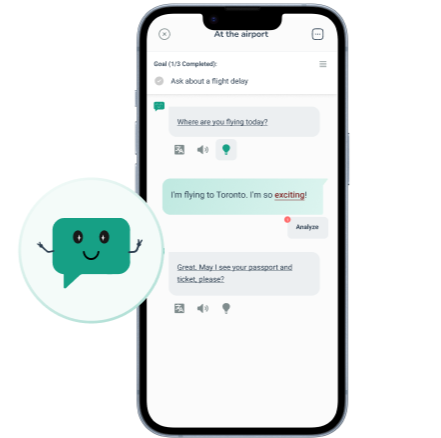
Download LingUp to continue the roleplay and get instant feedback on your grammar and pronunciation.
Try LingUp Now!Start with the 'm' sound. Close your lips and hum.
Move to the 'uh' sound /ʌ/, like in the word 'cup'. Your jaw should be relaxed and your mouth slightly open.
Finish with the /ŋk/ sound. The back of your tongue touches the soft roof of your mouth for the 'ng' /ŋ/ sound, then releases with a 'k' sound.
Pronouncing the vowel as 'o' in 'hot' (m-o-nk).
Pronouncing the vowel as 'o' in 'go' (m-oa-nk).
Using a separate 'n' sound instead of the 'ng' sound (m-un-k).
same as American
same as American
The vowel is /ʌ/. It is the same sound as the 'u' in 'cup' or 'sun'. Your mouth should be relaxed.
No, it's a sound cluster called /ŋk/. The back of your tongue makes the 'ng' sound /ŋ/ and then immediately adds a 'k' sound. Practice with words like 'think' and 'bank'.
'Monk' has only one syllable. All the sounds are said together quickly without any breaks.
A man who is a member of a religious group and lives separately from society.
/ˈmɑnəˌstɛri/
A building where monks live
/məˈnæstɪk/
Related to monks or monasteries
/ˈmʌŋkˌfɪʃ/
A type of large fish found in the sea
- 'Monk' has one syllable with an /ʌ/ sound. 'Monastery' has four syllables and starts with an /ɑ/ sound.
- The stress in 'monastic' is on the second syllable (-nas-), while 'monk' is a single stressed syllable.
- 'Monkfish' is a compound word. The first part, 'monk', is pronounced exactly the same.
The vowel sound /ʌ/ is very common. Practice it with words like 'cup', 'sun', and 'fun'. Then say 'monk'.
The /ŋk/ sound is also in 'think', 'pink', and 'bank'. If you can say those words, you can say 'monk'.